Final Fantasy (fin) | ||
| #201 ⸱ Uncommon ⸱ French | ||
 Variations— Parts— | Quête annexe : élever un chocobo
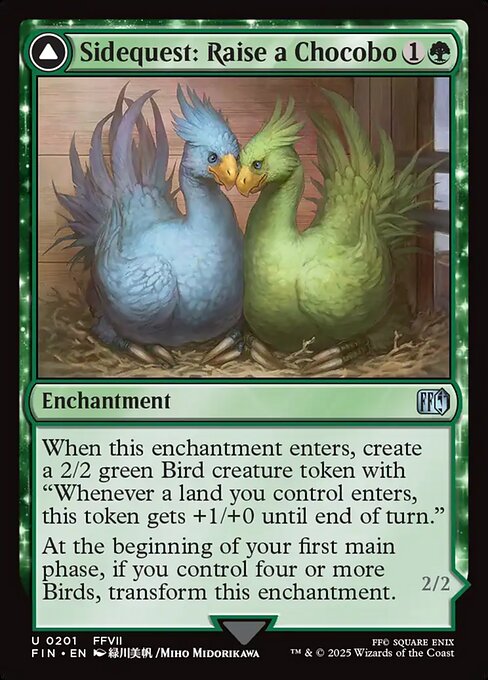
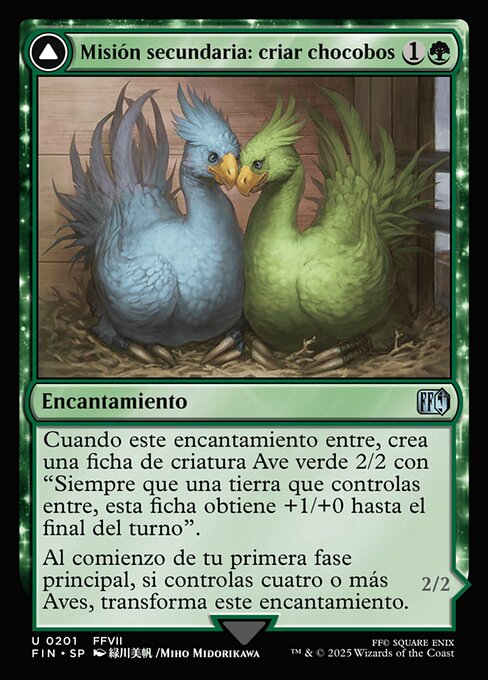
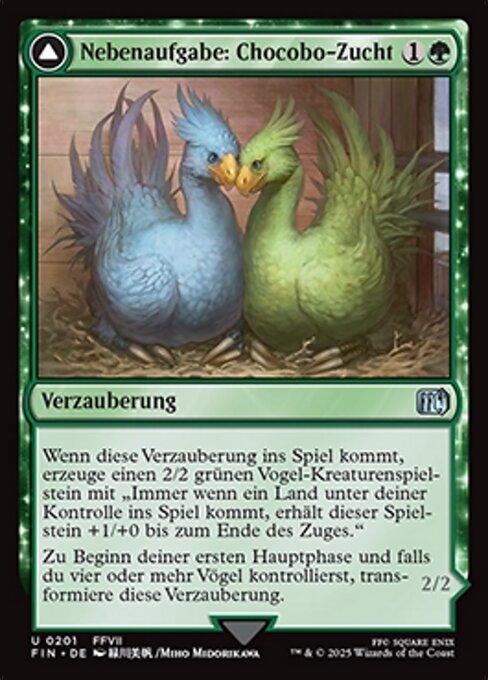
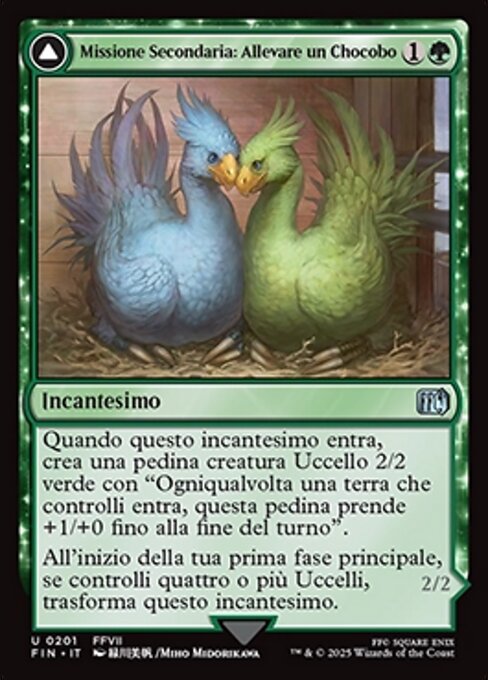
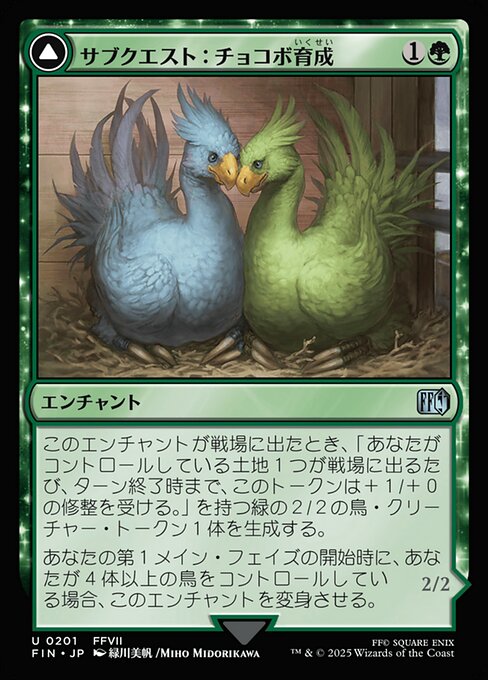
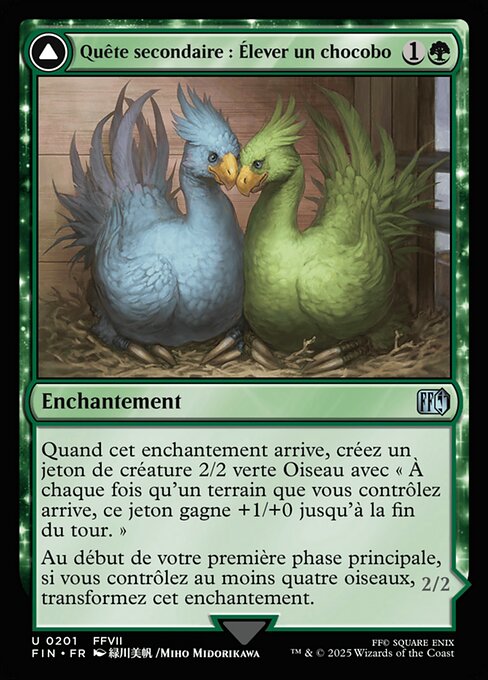
Quand cet enchantement arrive, créez un jeton de créature 2/2 verte Oiseau avec « À chaque fois qu'un terrain que vous contrôlez arrive, ce jeton gagne +1/+0 jusqu'à la fin du tour. » Au début de votre première phase principale, si vous contrôlez au moins quatre oiseaux, transformez cet enchantement.
Chocobo noir2 / 2 Quand ce permanent se transforme en Chocobo noir, cherchez dans votre bibliothèque une carte de terrain, mettez-la sur le champ de bataille engagée, puis mélangez. Toucheterre — À chaque fois qu'un terrain que vous contrôlez arrive, les oiseaux que vous contrôlez gagnent +1/+0 jusqu'à la fin du tour.
LegalitiesLegal Duel Brawl Future Legacy Modern Alchemy Pioneer Vintage Historic Standard Timeless Commander Gladiator Oathbreaker Standardbrawl Not Legal Penny Predh Pauper Oldschool Premodern Paupercommander RulingsThe back face of a nonmodal double-faced card usually has a color indicator that defines its color.
If you are instructed to put a card that isn't a double-faced card onto the battlefield transformed, it will not enter at all. In that case, it stays in the zone it was previously in. For example, if a single-faced card is a copy of Crystal Fragments, it will be exiled during the resolution of its second ability and remain in exile.
Sidequest: Raise a Chocobo's last ability checks at the moment it would trigger to see if you control four or more Birds. If you don't, the ability won't trigger at all. If it does trigger, the ability will check again as it tries to resolve. If you don't control four or more Birds at that time, the ability won't resolve and none of its effects will happen.
The mana value of a nonmodal double-faced card is the mana value of its front face, no matter which face is up.
Each face of a nonmodal double-faced card has its own set of characteristics: name, types, subtypes, abilities, and so on. While a nonmodal double-faced permanent is on the battlefield, consider only the characteristics of the face that's currently up. The other set of characteristics is ignored.
A token that is created as a copy of a double-faced permanent or a double-faced card in another zone is a double-faced token. It will have both the front face and back face of whatever object it's copying. If it's copying a double-faced permanent whose back face is up, the token will enter with its back face up. It can transform if instructed to do so.
If this card somehow enters the battlefield with its back face up, it didn't transform, so you won't search.
A nonmodal double-faced card enters with its front face up by default, unless a spell or ability instructs you to put it onto the battlefield transformed or allows you to cast it transformed, in which case it enters with its back face up.
In the Commander variant, a double-faced card's color identity is determined by the mana costs and mana symbols in the rules text of both faces combined. If either face has a color indicator or basic land type, those are also considered. For example, Cecil, Dark Knight's color identity is black and white, since its front face is black and its back face has a white color indicator.
Each nonmodal double-faced card in this release is cast face up. In every zone other than the battlefield, consider only the characteristics of its front face. If it is on the battlefield, consider only the characteristics of the face that's up; the other face's characteristics are ignored.
| Market Pricing
Printings
| |||||||||||||||||||||||||||||||||